

From identifying animals to learning about the weird and the wonderful objects you find, our team is ready to help!
To be or not to bee fly
I think this is a fly of some sort. They are around my house in Gympie during the summer months. They are quite slow flying and are easy to carefully herd outside. They fly alone, although I’ve seen two or three hovering or roosting together at times.
Answer
Yes, this insect only has ONE pair of flying wings so it is a fly (Order Diptera). The second pair are modified to function as balancing organs and are called halteres. There are many types of fly and identification from a photograph rather than a specimen can be very difficult, if not impossible, even for an expert! Fortunately, one of your photographs allows identification to family level. That is because the wings can be clearly seen from above. The branching pattern in wing veins provides important diagnostic information.
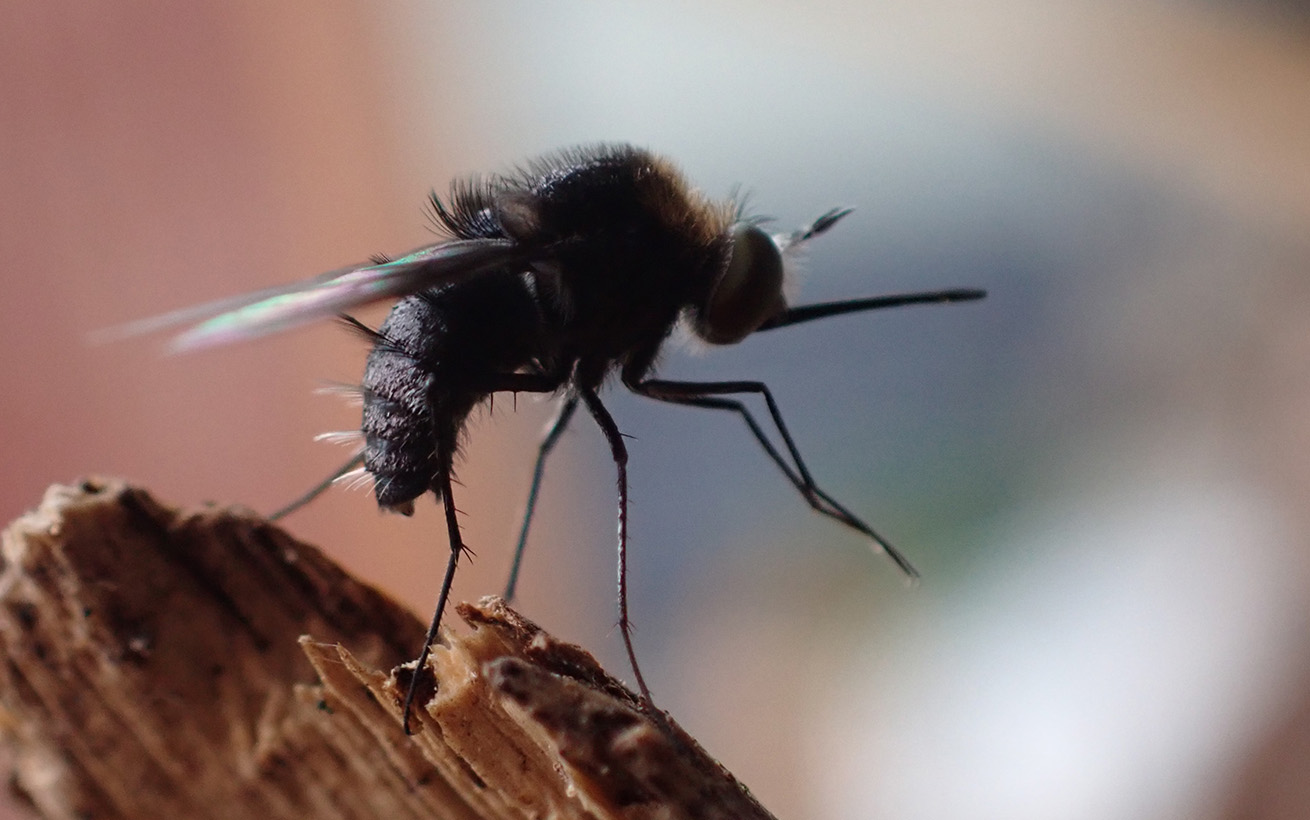
Your insect is a bee fly, the common name used for flies belonging to the family Bombyliidae. To take the identification further requires a real fly expert, a dipterist. Using highly specialised keys which require very detailed knowledge of fly anatomy, Dr Christine Lambkin (our dipterist!) was able to determine its subfamily and tribe (Bombyliinae; Bombylinii) and also its genus, Nigromyia.
Bee flies are so named because some of them mimic bees, as you can see in the picture of Meomyia fasciculata. Like bees, bee flies are important pollinators, as are members of many other fly families.
Australia has 100 families of flies, many of which don’t look much at all like your average House Fly (Musca domestica). They come in a wide variety of forms - long legged, big headed, small headed, wasp mimics, iridescent, and even wingless. Only about 7,500 of Australia’s estimated 30,000 fly species have been described and named.
And remember, if you want us to try to identify a fly take several photographs from different angles and in particular ones showing the wings (and their venation) from above. Other useful features are present on the fly’s head.
Want to know more? Queensland Museum's Discovery Centre is a free service open seven days per week, with experts ready to answer your questions. You can phone, write, contact us via our website or pop in. If we don’t know the answer, we will try to find it for you.
Date published: January 2023
Bee fly Nigromyia sp. Image: Nicole McMullen.
Bee fly Nigromyia sp. showing wing venation. Image: Nicole McMullen.
The bee mimic Meomyia fasciculata. Image: Geoff Thompson.