

Stay up to date and informed about upcoming exhibitions, school programs, classroom resources and teacher professional development events across Queensland.
Classification and Taxonomy
Year 7
Science
Facilitated by museum staff and additional teacher-led scavenger hunt
45 minutes per session, rotations for large groups will require a reset period. The time of self-led scavenger hunt is at the discretion of the teacher.
Enhance your visit to Queensland Museum Tropics with our facilitated school program Classification and Taxonomy where students explore biological classification through hands-on shell investigation, using dichotomous keys to identify molluscs and apply understanding across phylum, classes and orders in museum galleries.
About the Program
Students investigate how scientists classify living things through a hands-on shell classification activity using real specimens. They learn that seashells are made by molluscs and explore key differences between major groups such as gastropods and bivalves, using dichotomous keys in written step-by-step and visual branching formats.
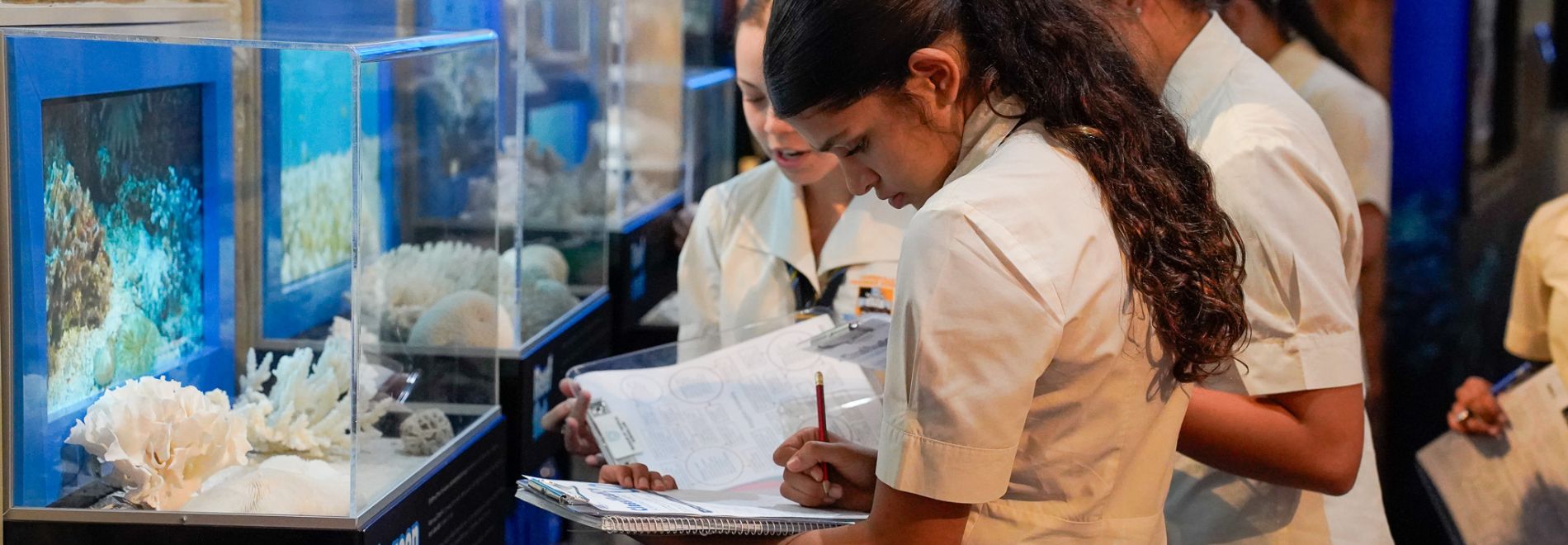
Following the facilitated session, students complete a self-led scavenger hunt in the Museum’s Level 2 Galleries, applying their understanding of classification across phylum, classes and orders.
Learning outcomes
Students will:
- investigate how scientists classify living things based on observable features and shared characteristics
- identify that seashells are made by molluscs and distinguish between major mollusc groups, including gastropods and bivalves
- use dichotomous keys in written and visual formats to identify specimens
- apply correct classification terminology, distinguishing between phylum, classes and orders
- record and organise observations using appropriate representations such as tables
Curriculum Links and Program Information
V9.0 Australian Curriculum links for the program
Year 7, Science |
|
|
Science Understanding |
|
|
Biological sciences |
Investigate the role of classification in ordering and organising the diversity of life on Earth and use and develop classification tools including dichotomous keys (AC9S7U01) |
|
Science inquiry |
|
|
Processing, modelling and analysing |
Select and construct appropriate representations, including tables, graphs, models and mathematical relationships, to organise and process data and information (AC9S7I04) |
Visit as a school
Everything you need to know to plan your school group visit to Queensland Museum Tropics.
Plan your school visit
What you need to know to plan your school visit.
School booking form
Book your school visit today.
What's on
View our calendar of exhibitions, events, activities and school programs.
Learn & Discover
Learn from our experts and discover Queensland's natural and cultural history through articles, images, blogs and podcasts.
Accessibility
Accessibility and sensory information to help you plan your visit to Queensland Museum Tropics.