Future Makers STEM Inventors Challenge — Western Downs Region
Register by: Friday 15 May
Launch:
Term 2, Week 5
Week starting Monday 18 May
Judging:
Term 3, Week 4
Friday 7 August
|
Western Downs |
|
| Free |
2026 REGISTRATIONS OPEN NOW
The STEM Inventors Challenge is open to students in Primary Years 5–6 and Secondary Years 7–10, based in the Western Downs local government area (surrounding regions may be considered). Participation is free. Teachers are encouraged to enrol their classes, STEM clubs, or supervised teams of motivated students. Home Education students are welcome.
For the first time, Primary and Secondary students will compete in two separate categories.
Working in groups of 2–4, students will have 10 weeks to:
- Learn relevant Science and Design & Technology principles from provided classroom activities
- Devise a STEM-based solution in response to the 2026 challenge
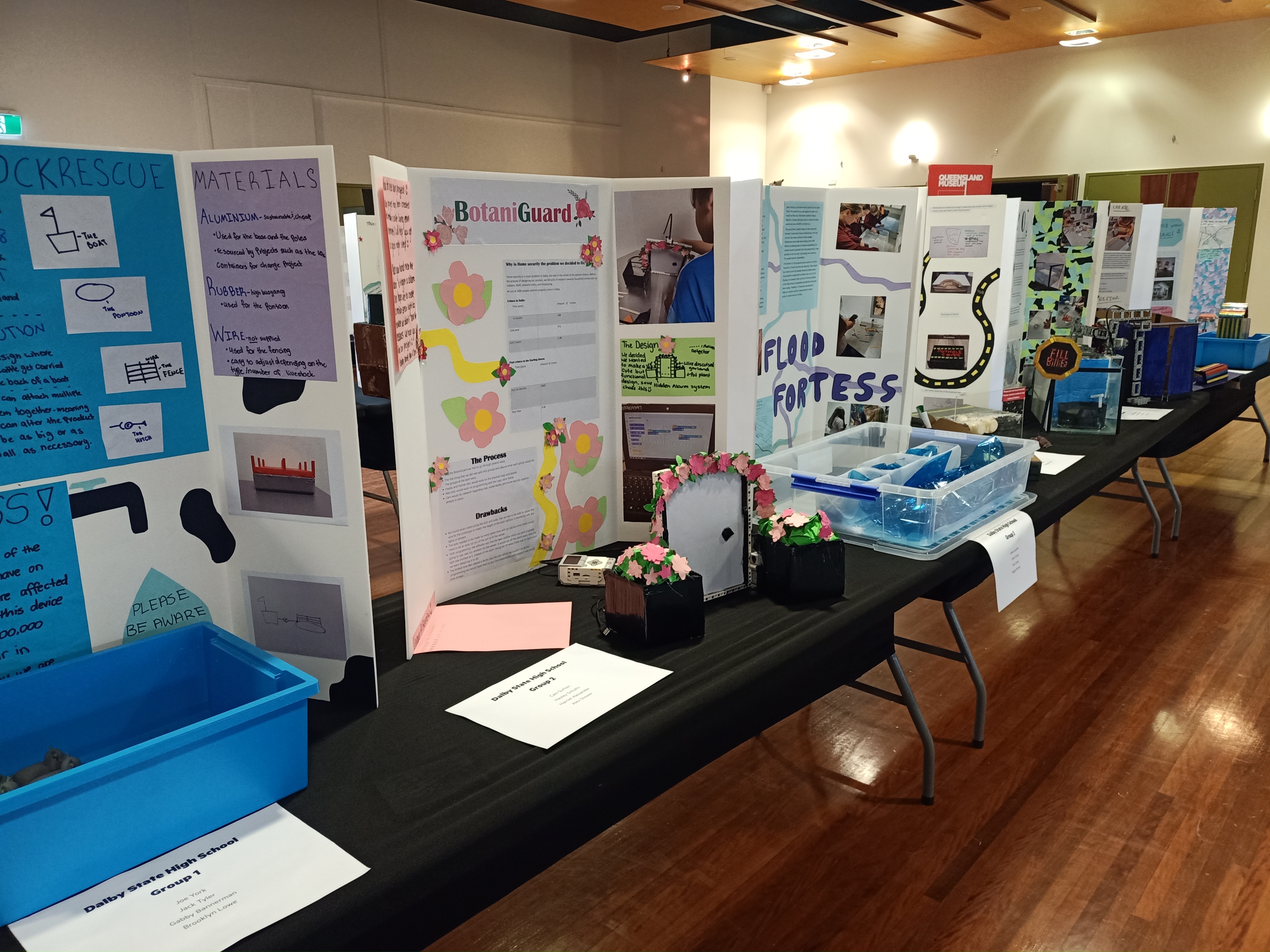
- Create a prototype and informative tabletop display board that demonstrates key capabilities or design aspects of their proposed solution.
To create their prototype, students are encouraged to use recycled products or materials they already own such as Lego, cardboard, craft supplies or 3D printing.
The students’ prototype exhibitions will be judged by an expert panel during a celebratory event at World Science Festival Queensland Student Day Chinchilla, on Friday 7 August. (NOTE: Registration to the STEM Inventors Challenge is inclusive of a secured booking – you do not need to register students separately for the festival.)
Read about Past Western Downs Winners.
THE 2026 CHALLENGE
Spectacular Species Solutions
Spectacular Species Solutions explores the integrative thinking, delicacy and innovation required for effective environmental management. It challenges students to think about their environment as a complex and connected system. Students will explore species control and conservation strategies, and design a SPECTACULAR solution to a problem impacting or caused by a Queensland species.
WHAT’S INCLUDED?
- A 45-minute launch webinar with Queensland Museum staff to introduce the challenge, give inspiring examples and outline steps to success
- Teaching manual with 10 weeks of hands-on, curriculum-aligned activities, as well as challenge judging criteria
- Student activity booklet for each participating student
- A tri-fold tabletop display board for each student team
- Optional mentoring opportunity with Queensland experts, including scientists, engineers and designers.
- Exclusive showcase space for each student team at World Science Festival Queensland Student Day in Chinchilla, with allocated time to enjoy festival activities. Snacks provided. Award winners will be announced on the day.
PRIZES
A Winner, Highly Commended, Commended and People’s Choice Award will be announced for each category (Primary and Secondary).
| Award | School Prize | Student Prize (each team member) |
| Winner | $1,000 cash and prize pack of Queensland Museum publications |
Trophy, certificate and large STEM prize pack |
| Highly Commended | $500 Queensland Museum voucher * | Certificate and small STEM prize pack |
| Commended | $150 Queensland Museum voucher * | Certificate and STEM prize |
| People’s Choice Award | Prize pack of Queensland Museum publications |
Certificate and STEM prize |
* Vouchers can be used towards items from the Queensland Museum shop (online or in-store), school programs (including online incursions) and exhibitions at Queensland Museum Kurilpa, Cobb+Co and Rail Workshops.
Mentor Expressions of Interest
We are calling for suitably qualified and available professionals (or retired professionals) in the areas of science, engineering and design to be STEM Mentors for 2026. STEM Mentors commit to participate in three, 30-minute video call sessions with student teams, to assist them in refining their inventive ideas. Expertise in biological sciences is particularly relevant to this year's challenge, however all manner of expertise is deeply valued for this voluntary opportunity with Queensland Museum. In Western Downs, sessions will be weekly between Monday 1 June and Friday 17 July. Email futuremakers@qm.qld.gov.au for more information.
< Discover more Future Makers initiatives

Past Winners — Western Downs region

Year 9 students Tom, Zaylee, Camryn and Kirsty from Chinchilla State High School were awarded as the Western Downs regional winners of the 2025 Future Makers STEM Inventors Challenge, in a celebration on the first day of World Science Festival Queensland Chinchilla. The students impressed judges with their inventive prototype called Helping Wings — a supply transportation drone for flood or drought affected farmers. Presented in a highly detailed tabletop display, the drone would be engineered for high weight capacity, extended flight endurance, weather resilience and precision delivery of hay and other essential supplies via a downloadable app. The students even considered the need for ample warehousing and a hub for drone landing and take-off. Together with other student competitors, the winning entry remained on display for the community to enjoy for the remainder of World Science Festival Queensland Chinchilla.

Aspiring Year 6 inventors Dallas Brown, Elio Wise and Alfie O’Donnell wowed judges with their design concept called Snaker’s Rescue — a one-stop smartphone app for snakebite prevention and emergencies. Designed for regional families and bushwalkers, the proposed app would enable the user to identify snake species using photographic Artificial Intelligence (AI), before sharing sightings to other users via an interactive map. As part of the detailed design submission, Dallas, Elio and Alfie programmed a talking Picoh educational robot to demonstrate a voice-activated AI assistant feature, able to contact emergency services and provide first aid instructions. The students also outlined an estimated development budget, highlighting the app’s snake catcher speed-dial portal as a potential advertising revenue stream.

Chinchilla Christian College students Zoe, Mia and Gabby designed a concept of a bushfire extinguishing drone, to address the its devasting affect on native animal habitats. The drone would have the ability to identify fires using Artificial Intelligence and thermal detection technology. Once hovering over the burning area, the drone would pop a C02 powder "bomb", encased in a thin, balloon-like, biodegradable material. To demonstrate their concept, the students made a basic prototype and conducted experiments using 100ml of C02 powder, measuring the average distance that the powder visibly travelled when dropped from a two metre height.