

Stay up to date and informed about upcoming exhibitions, school programs, classroom resources and teacher professional development events across Queensland.
Extreme Adaptations
Year 5 & 6
Science - Biological Sciences
Facilitated by museum staff
60 minutes per session, rotations for large groups will require a reset period.
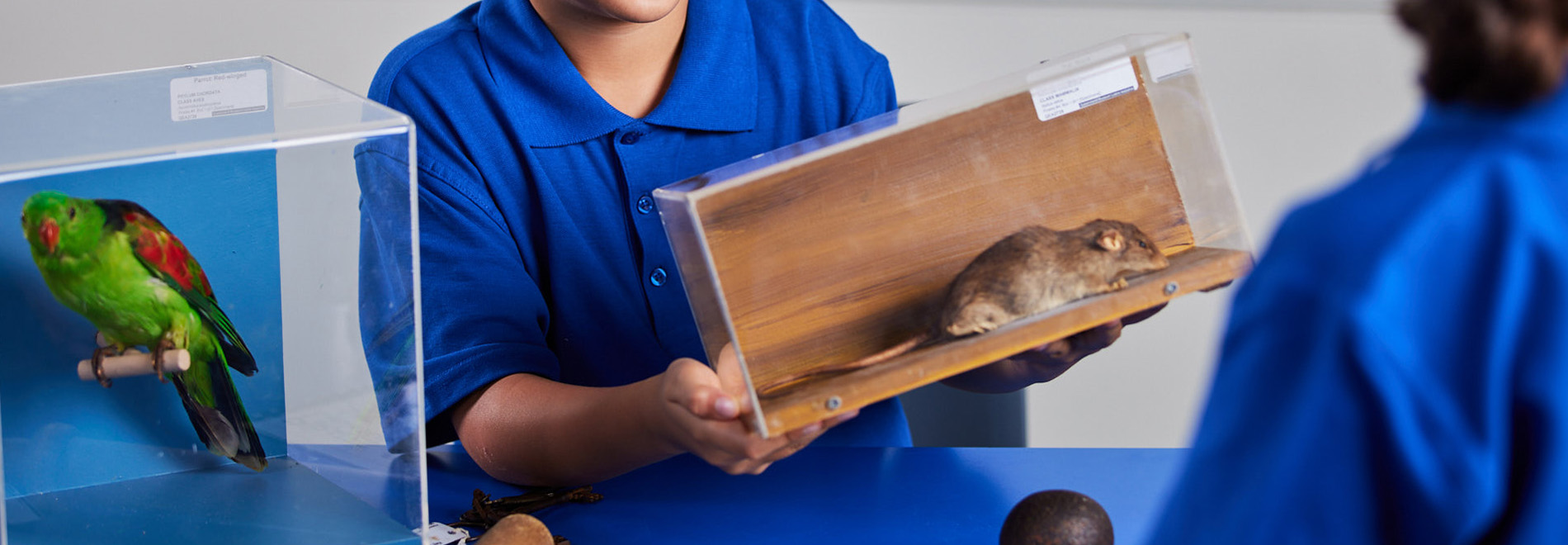
Enhance your visit to Queensland Museum Tropics with our facilitated school program Extreme Adaptations where students investigate how animals and plants have adapted to live in different natural environments.
About the Program
Join our museum facilitators as they guide students in the role of futuristic astrobiologists, preparing for missions to distant planets with extreme environments.
Students will explore a range of natural environment displays, including the deep sea, mangroves, and rainforest. Through these experiences, they will investigate the diverse animals and plants that inhabit these environments and identify the behavioural and structural adaptations that support their survival.
Building on this knowledge, students will work in small groups to creatively design a new species adapted to an extreme planetary environment. Each group will then present their design and decision-making processes to classmates as part of a mini “Species Showcase”.
Learning outcomes
Students will:
- recognise and understand the function of adaptations that enable living things to survive in extreme environments
- differentiate between behavioural and structural adaptations
- identify the environmental factors that influence adaptations and how changes in these factors might impact the survival of living things
- describe and communicate their understanding of these features through verbal explanation and drawings/diagrams.
Curriculum Links and Program Information
Download the Program Guide for more information including how to book, what to expect, and the v9.0 Australian Curriculum links for the program.
Year 5 Science |
|
|
Science understanding |
|
|
Biological sciences |
Examine how particular structural features and behaviours of living things enable their survival in specific habitats (AC9S5U01) |
|
Science Inquiry |
|
|
Questioning and predicting |
Pose investigable questions to identify patterns and test relationships and make reasoned predictions (AC9S5I01) |
|
Processing, modelling and analysing |
Construct and use appropriate representations, including tables, graphs and visual or physical models, to organise and process data and information and describe patterns, trends and relationships (AC9S5I04) |
|
Communicating |
Write and create texts to communicate ideas and findings for specific purposes and audiences, including selection of language features, using digital tools as appropriate (AC9S5I06) |
Year 6 Science |
|
|
Science understanding |
|
|
Biological sciences |
Investigate the physical conditions of a habitat and analyse how the growth and survival of living things is affected by changing physical conditions (AC9S6U01) |
|
Science Inquiry |
|
|
Questioning and predicting |
Pose investigable questions to identify patterns and test relationships and make reasoned predictions (AC9S6I01) |
|
Processing, modelling and analysing |
Construct and use appropriate representations, including tables, graphs and visual or physical models, to organise and process data and information and describe patterns, trends and relationships (AC9S6I04) |
|
Communicating |
Write and create texts to communicate ideas and findings for specific purposes and audiences, including selection of language features, using digital tools as appropriate (AC9S6I06) |
Visit as a school
Everything you need to know to plan your school group visit to Queensland Museum Tropics.
Plan your school visit
What you need to know to plan your school visit.
School booking form
Book your school visit today.
What's on
View our calendar of exhibitions, events, activities and school programs.
Learn & Discover
Learn from our experts and discover Queensland's natural and cultural history through articles, images, blogs and podcasts.
Accessibility
Accessibility and sensory information to help you plan your visit to Queensland Museum Tropics.