

Stay up to date and informed about upcoming exhibitions, school programs, classroom resources and teacher professional development events across Queensland.
100 Million Years Ago
Prep – Year 1
Science
Facilitated by museum staff
60 minutes per session, rotations for large groups will require a reset period.
Enhance your visit to Queensland Museum Tropics with our facilitated school program 100 Million Years Ago where students investigate a variety of prehistoric animals and learn about the field of palaeontology.
About the Program
Join our museum facilitators for a dino-hunt adventure as students step into the role of junior trainee palaeontologists. Students will learn to distinguish between dinosaurs, ancient marine reptiles, and ancient flying reptiles featured throughout the museum’s exhibitions.
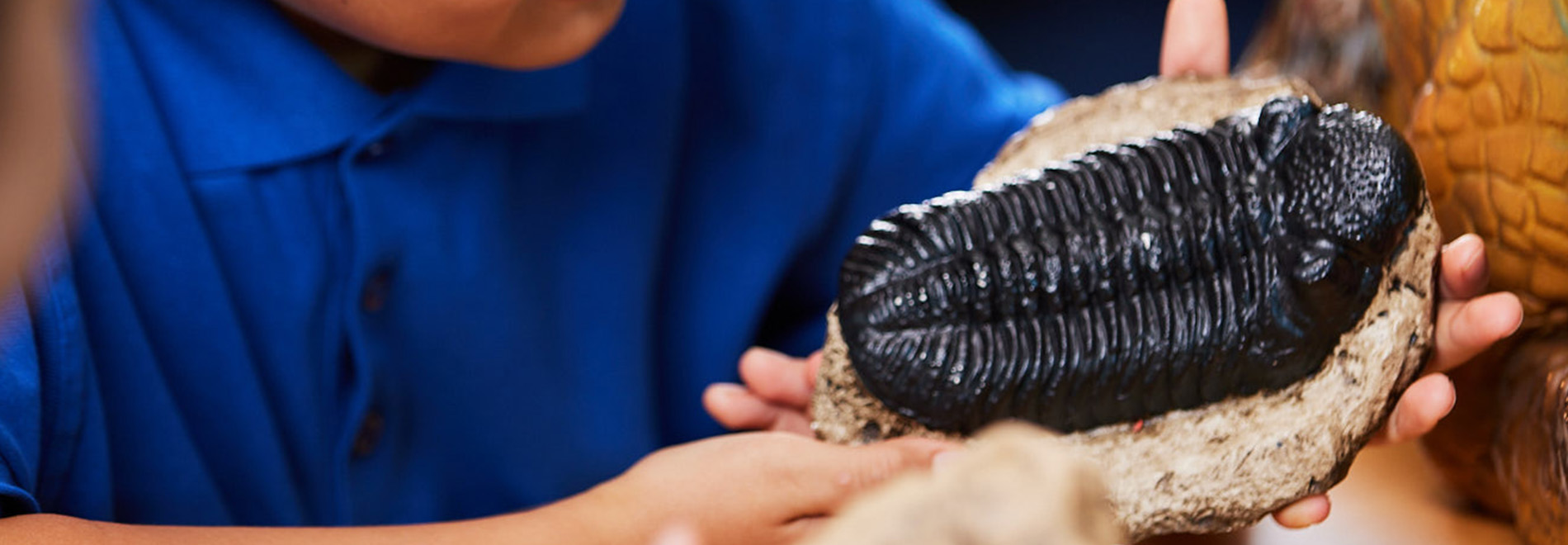
Students will engage hands-on with real and replica fossilised remains and trace fossils, analysing the materials and forming hypotheses about the animals and plants they represent.
They will then apply their understanding of prehistoric physical features by designing their own dinosaur masks before embarking on a dino-stomp scavenger hunt. Along the way, students will identify different specimens, discuss what these creatures may have eaten, where they lived, and compare them with animals living today.
Learning outcomes
Students will:
- understand the nature and purpose of palaeontology and how palaeontologists contribute to our understanding of the natural world
- identify features of dinosaurs, ancient marine reptiles and ancient flying reptiles
- pose questions and form interpretations about the diets and habitats of animals that lived in the past
- communicate their observations and ask questions using key palaeontological and science terms.
Curriculum Links and Program Information
Download the Program Guide for more information including how to book, what to expect, and the v9.0 Australian Curriculum links for the program.
Foundation, Science |
|
|
Science Understanding |
|
|
Biological sciences |
Observe external features of plants and animals and describe ways they can be grouped based on these features (AC9SFU01) |
|
Science as a human endeavour |
|
|
Use and influence of science |
Explore the ways people make and use observations and questions to learn about the natural world (AC9SFH01) |
|
Science inquiry |
|
|
Question and predicting |
Pose questions and make predictions based on experiences (AC9SFI01) |
|
Planning and Conducting |
Engage in investigations safely and make observations using their senses |
|
Processing, modelling and analysing |
Represent observations in provided templates and identify patterns with guidance (AC9SFI03) |
|
Evaluating |
Compare observations with predictions with guidance (AC9SFI04) |
|
Communicating |
Share questions, predictions, observations and ideas with others (AC9SFI05) |
Year 1, Science |
|
|
Science Understanding |
|
|
Biological sciences |
Identify the basic needs of plants and animals, including air, water, food or shelter, and describe how the places they live meet those needs (AC9S1U01) |
|
Science as a human endeavour |
|
|
Use and influence of science |
Describe how people use science in their daily lives, including using patterns to make scientific predictions (AC9S1H01) |
|
Science inquiry |
|
|
Question and predicting |
Pose questions to explore observed simple patterns and relationships and make predictions based on experiences (AC9S1I01) |
|
Planning and Conducting |
Make and record observations, including informal measurements, using digital tools as appropriate (AC9S1I03) |
|
Processing, modelling and analysing |
Sort and order data and information and represent patterns, including with provided tables and visual or physical models (AC9S1I04) |
|
Evaluating |
Compare observations with predictions and others’ observations, consider if investigations are fair and identify further questions with guidance (AC9S1I05) |
|
Communicating |
Write and create texts to communicate observations, findings and ideas, using everyday and scientific vocabulary (AC9S1I06) |
Visit as a school
Everything you need to know to plan your school group visit to Queensland Museum Tropics.
Plan your school visit
What you need to know to plan your school visit.
School booking form
Book your school visit today.
What's on
View our calendar of exhibitions, events, activities and school programs.
Learn & Discover
Learn from our experts and discover Queensland's natural and cultural history through articles, images, blogs and podcasts.
Accessibility
Accessibility and sensory information to help you plan your visit to Queensland Museum Tropics.